Introduction
The first chapter of Poppy Playtime, "Tight Squeeze," was released in October 2021. It lasts only about an hour, but in that time it creates a sticky, unrelenting dread that keeps you coming back to the abandoned factory again and again. Most players run through it in one fell swoop: pull levers, run away from Huggy, open the crate with Poppy. But if you slow down, turn on a flashlight and start looking at the walls, you'll find that MOB Entertainment has hidden so many details in this short chapter that they'd be enough for a full prequel.
Here, every note, every drawing on the wall and every random rustle works towards one goal - to tell the story of a factory that devours people. We've rounded up all the passphrases, hidden messages, and environment details that 90% players will miss. After this breakdown, you won't be able to look at Tight Squeeze the same way again.
1. Huggy has been watching you from the beginning.
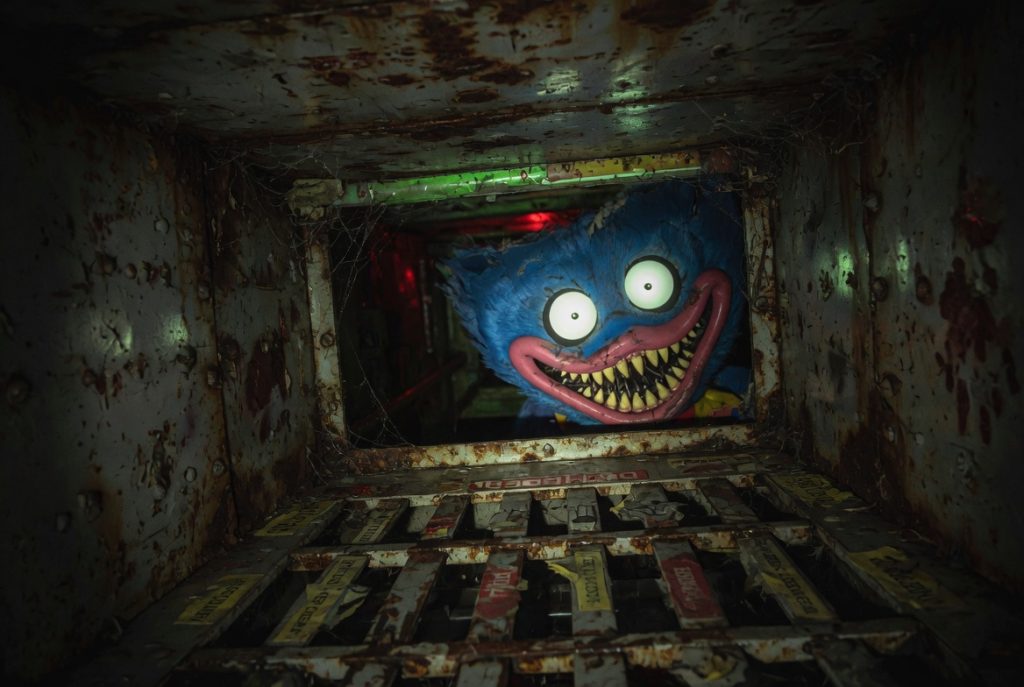
The most famous, yet still underrated, passphrase of the first chapter is the behavior of Huggy Wuggy. Many people notice the statue's disappearance in the main hall, but few track his movements throughout the passage.
Here's a chronology of player observation:
- Main Foyer. Huggy's statue stands on a pedestal. As soon as the player restores power in the electrical room and returns back - the statue disappears. From that moment on, Huggy is active .
- Warehouse. In the area where you collect the batteries, Huggy peeks out of the vent. If you come closer and meet his gaze, he slowly crawls back into the darkness - and the vent slams shut with a clang .
- Factory corridors. In a few places, you may notice blue fur and long limbs flickering around corners or at the edge of the frame. These aren't bugs or hallucinations - it's Huggy checking to see how far you've gotten .
- Before the chase. Just before Huggy jumps out of the dark corridor, you can hear his heavy footsteps and the scraping of claws on metal.
Conclusion: Huggy is not just a scripted threat, but an elaborate hunter who methodically stalks his prey.
2. Writing with errors
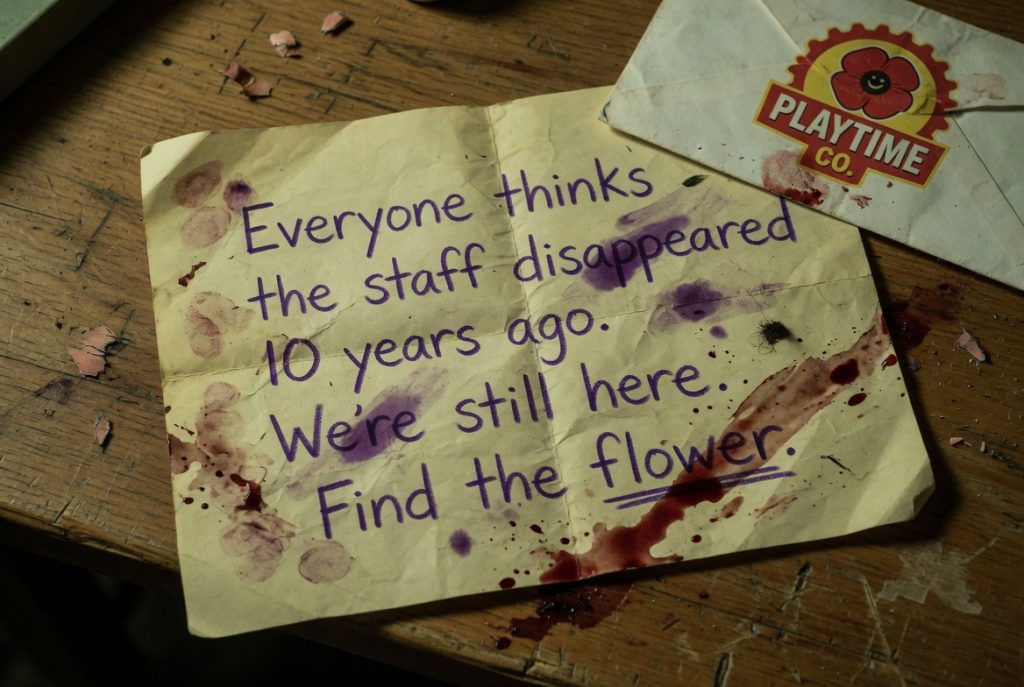
At the very beginning of the game, the protagonist receives a letter. Its text reads: "Everyone thinks the staff disappeared 10 years ago. We're still here. Find the flower.". At first glance, it's an ordinary tie-in. But look closer:
- Word disappeared written with a grammatical error - as if written by a child or someone who hasn't held a pen in his hands for a long time.
- In the word we're the apostrophe is in the wrong place.
- The message itself contradicts the game's official description: the letter says that the employees are still in the factory, while the synopsis says that everyone has disappeared.
Who wrote that letter? Poppy? The prototype? Huggy himself? At the time of the first chapter, there's no answer - but the fact that the developers deliberately inserted errors suggests the non-human nature of the sender.
3. Hanging toys is a message
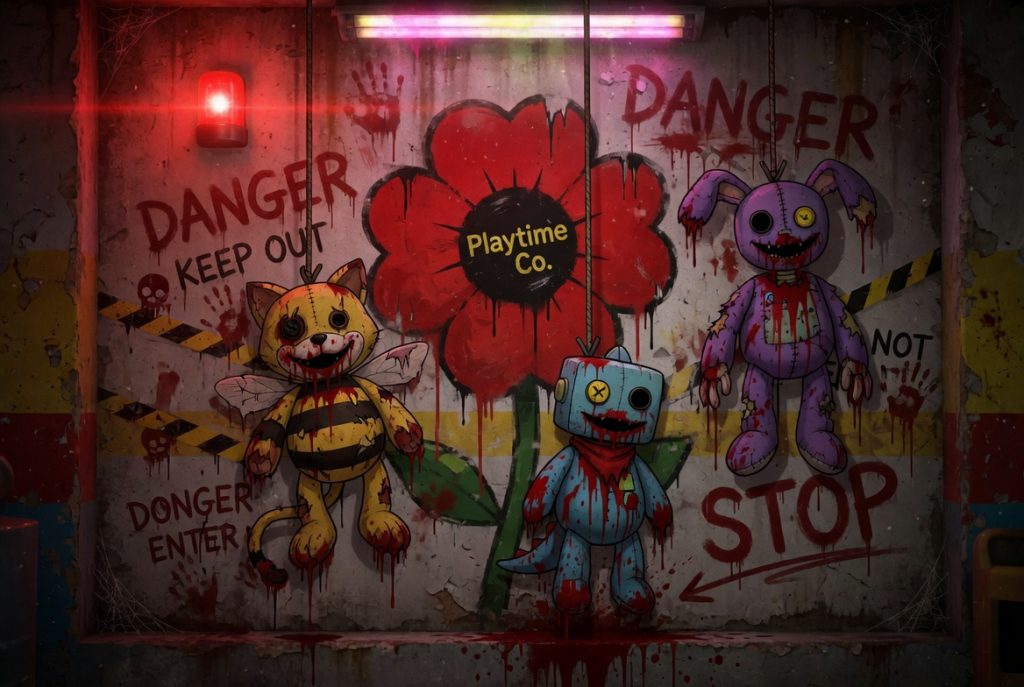
Before entering Poppy's room, the player walks across a long metal bridge. On the wall around a huge painted poppy flower are toys: two Cat-Bees, Bron and Boogie Bot . They are not just hanging - they are literally hung, as if on a gallows. Around them are hurried inscriptions: "DANGER," "STOP," "RUN." .
If at the beginning of the game you collected parts for Cat-Bee on the Make-A-Friend assembly line and brought the toy to life, here you see the same Cat-Bee - but already dead and hanging. This is no accident: someone in the factory is purposely destroying the experiments.
The creepiest part is the blood. On the toys themselves, on the wall, on the drawings. It's not decorative paint. Since in Poppy Playtime lore, the toys are created from human material, the blood on the hanging experiments is the blood of real people who once worked or lived in the factory .
4. The poppy is not just a flower
The poppy flower is the central symbol of the first chapter. It is the one the letter tells us to find: "Find the flower.". The door to Poppy's room is surrounded by a giant drawing of a poppy. And it's not a random choice.
In the real world, poppies symbolize memory, death, and sleep . In many cultures, red poppies are associated with the blood spilled on battlefields and are used as a symbol of memorializing the dead. In the context of Poppy Playtime, this symbolism works on several levels:
- Sleep. Poppy is literally asleep in her glass case, and the player awakens her.
- Death. The factory is full of deaths, and the flower points the way to where a major mystery is hidden.
- Memory. The entire game is built around revisiting a forgotten past - both for the protagonist and the factory itself.
Moreover, it is later revealed that poppy is a key component of Poppy Gel, a substance used to transfer human consciousness into toys . So the flower is not just a symbol, but a literal ingredient of horror.
5. The Make-A-Friend machine is watching you
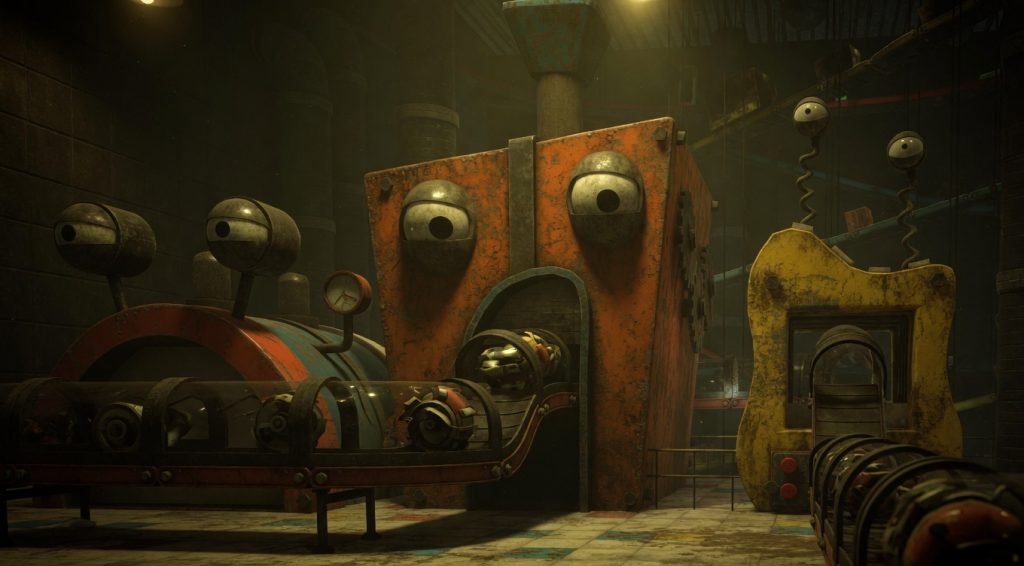
In the production area, the player assembles a Cat-Bee toy using a huge Make-A-Friend machine. This machine has two large eyes with small pupils, and they are not static - they move.
As you walk around the room, picking up parts and activating the conveyor belt, the machine's eyes follow your every move. No screemer occurs, but the realization comes later: why does a factory machine even have eyes?
The answer lies in the general philosophy of Playtime Co.: there are no mere machines here. All meaningful mechanisms in the factory are either experiments or part of experiments. Make-A-Friend is no exception. She doesn't just make toys; she is one herself.
6. Huggy's bleeding out
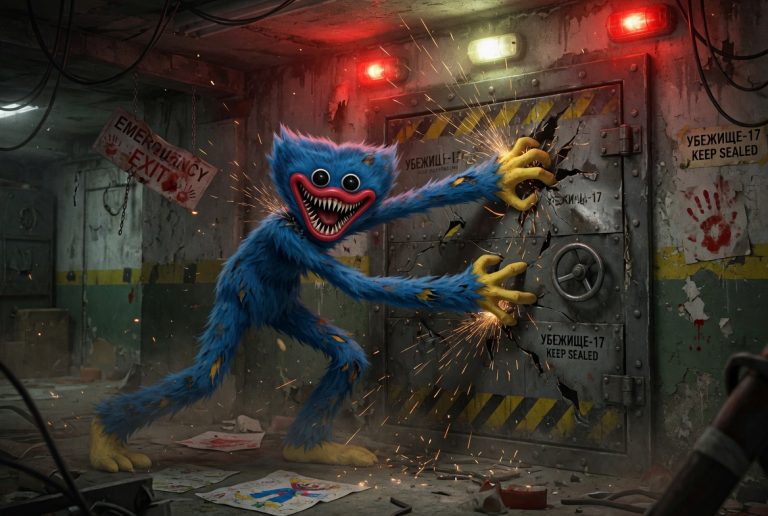
The final chase ends with Huggy Wuggy falling from a great height. The player drops a crate on him, the bridge collapses, and Huggy flies into the abyss, hitting metal beams and pipes.
If you look closely at the impact sites, you can see dark blood stains. It's not oil or lubricant or gel-- it's blood. Real, organic blood.
Why is this important? Because Huggy Wuggy isn't just a plush toy brought to life. It's a #1170 experiment created from human material as part of the Big Body Initiative. Behind the soft blue fur and creepy smile is flesh - and it bleeds when wounded.
Additional confirmation is the death scenes of the protagonist. If Huggy catches up with you during a chase, a close-up of his mouth is shown: behind the plastic shell of his outer shell are real human eyes.
7. Posters with scary rules
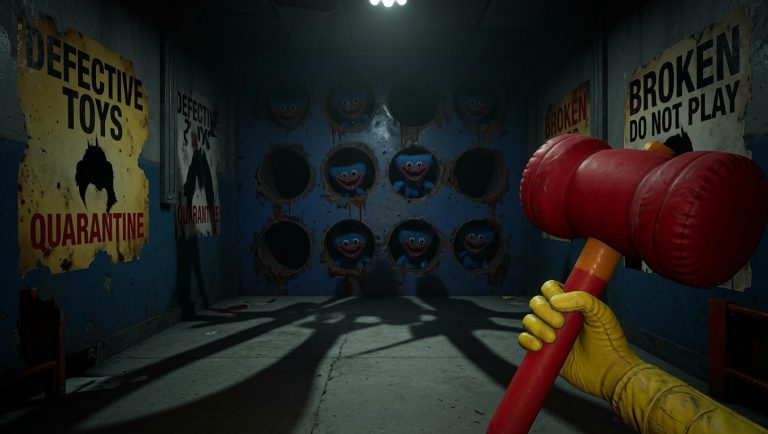
The posters scattered around the factory are more than just decor. If you stop and read them, the picture of working conditions at Playtime Co. becomes frighteningly clear:
- "Playtime Co. recommends a daily intake of 4,000 calories". The normal norm for an adult is 2000-2500. Why do employees need twice that? To keep the body in a condition suitable for experimentation.
- "Breaks longer than 10 minutes are prohibited." The staff had to be on duty at all times.
- "No hiding behind doors to scare Leith Pierre." The only joking rule - but it's telling that even the head of security was afraid to walk around his own factory.
- "Give the gift of happiness: adopt an orphan TODAY." This is the creepiest poster ever. Playtime Co. didn't just call for adoption - the company purposely sought out children for experimentation. All of the series' main antagonists were once orphans adopted through this program.
8. Black videotape
In front of the entrance to Poppy's room, a black videotape lies on the metal bridges. Most players run past it in their rush to the finals. But if you pick up a cassette tape and insert it into the black VCR to the right of the door, you can see the recording.
The contents of this tape are one of the first direct indications of what was happening to the employees of the factory. The experiments spiraled out of control long before the protagonist arrived, and those who didn't escape in time were left inside. The tape serves as a bridge between the light-hearted commercial at the beginning of the chapter and the horror that is revealed in the moments that follow.
9. The secret door in Poppy's room
The interior of Poppy's room - a nursery with wooden furniture, blue cushions and a huge dollhouse in the corner - has one detail that can't be activated but raises questions: a secret door hidden behind the closet.
The player cannot move the closet and open this door in the first chapter - it is inaccessible. But its very presence hints that Poppy's room is not a dead end, but a crossroads. Where does this door lead? To other experiments? To the Prototype's private quarters? That question remains open.
Read also: How to open the door to the security room
10. A melody that plays itself
When the player approaches Poppy's room, a quiet, soft melody begins to play. It's not like the rest of the music in the game - no tension, no industrial notes, just a glassy, fragile sound reminiscent of a music box .
Who's running it? Poppy locked in a drawer? The house itself reacting to the visitor? Or is it part of a system designed to lure the visitor inside? The final scene - when the player opens the box, the lights go out, and Poppy utters You opened my box - doesn't provide an answer, but it does leave a sense that this awakening was no accident.
Table: All Chapter 1 Paschals at a Glance
| Passover | Where to find | Why it's important |
|---|---|---|
| Huggy's watching from the vents | Battery storage | Proves that Huggy is a hunter, not a random threat |
| A misspelled letter | The very beginning of the game | Indicates the non-human nature of the sender |
| Hanging toys | The bridges in front of Poppy's room | Warning from surviving employees |
| Poppy symbolism | The door to Poppy's room | The connection to death, sleep and Poppy Gel |
| Make-A-Friend's eyes | Production hall | The implication is that all of the factory's machines are alive |
| Huggy's blood | The final chase | Confirms the organic nature of the experiments |
| Posters with rules | Different areas of the factory | Revealing the true purpose of Playtime Co. |
| Black videotape | The bridges in front of Poppy's room | A hidden record of the fate of employees |
| Secret door | Poppy's room | Leads to an unknown part of the factory |
| Poppy's tune | The hallway in front of her room | Hypnotic influence on the visitor |
FAQ
Question 1: Why is the letter at the beginning of the game misspelled?
The errors in the words disappeared and we're indicate that the sender is not a literate adult, but rather a child or a toy imitating children's handwriting. The developers deliberately inserted these inaccuracies as a clue to the non-human nature of the author.
Question 2: Is Huggy alive after the fall?
At the time of the first chapter, yes, his fate remains uncertain. Blood at the impact sites indicates that he is injured, but not necessarily killed. In later chapters, his return proves that the fall did not destroy him.
Question 3: Who hung the toys at Poppy's front door?
Most likely done by surviving factory employees or other experiments in protest or warning. The blood on the toys and the inscriptions RUN and STOP indicate the human origin of this memorial.
Question 4: Why is the poppy flower so important?
Poppy is a symbol of death, sleep, and memory. In Poppy Playtime lore, it is also a key component of Poppy Gel, a substance used to transfer consciousness into toys.
Question 5: What is behind the secret door in Poppy's room?
In the first chapter, this door is inaccessible. It is hidden behind a cabinet and the player cannot open it. Presumably, it leads to deeper levels of the factory or the Prototype's private quarters.
Question 6: Why did Playtime Co. encourage the adoption of orphans?
The company used orphans as test subjects for experiments on transferring consciousness into toys. The children were ideal candidates: no one would look for them, and their young bodies were better able to tolerate the transformation.
Question 7: Why does the Make-A-Friend machine have eyes?
This is a hint that all significant machinery in the factory is either an experiment or part of one. The machine observes the player, assessing a potential threat or potential material.
Question 8: What is on the black videotape?
It records the events surrounding the disappearance of employees and the failure of experiments. It is one of the first direct indications of the scale of the disaster that occurred at the factory.
Question 9: Is Poppy really a doll?
At the time of the first chapter, it seems that she is. But the final phrase You opened my drawer and the symbolism of the poppy hint that she is much more than that. Later chapters reveal her true nature.
Question 10: Is it possible to find all the paschalas in one playthrough?
Yes, the first chapter is quite short and linear. In order not to miss details, move slowly, examine the walls, read all the posters and be sure to look in dark corners with a flashlight.
Conclusion
Poppy Playtime Chapter 1 isn't just an hour-long run before the larger chapters. It's a tightly packed box of secrets that rewards the most attentive players. Every detail here works for the story, from grammatical errors in writing to bloodstains on the walls around Poppy's room. MOB Entertainment didn't just make a horror game - they created a detective story that players are still unraveling to this day.
Next time you go through Chapter 1, take your time. Stop at the poster. Look around the corner. Look up. The Playtime Co. factory is talking to you - you just have to learn to listen.

 English
  Русский
  Español
  Português do Brasil
  Türkçe
  Deutsch
  Français