Introduction
When a player crosses the threshold of the Playtime Co. factory for the fifth time, he expects no mercy. But even seasoned horror veterans were not prepared for the kaleidoscope of faces - friendly and downright hostile - that Poppy Playtime Chapter 5: Broken Things unleashes upon them. While the previous chapters introduced us to single antagonists like Mommy Long Legs or Napa the Kitten, here the camera pulls back to reveal an ecosystem of tortured, twisted, and desperately clinging to life.
All of these characters aren't just new monsters to scrimmage. They are the missing pieces of a mosaic that finally explains the true nature of the Prototype and the extent of the tragedy of the Joy Hour. Each character in Chapter Five - from the mad doll Lily to the broken but not surrendered Giblet - adds a unique touch to the portrait of the series' main antagonist.
In this article we'll lay out all the significant characters of Broken Things: their history, motivation and - most importantly - the invisible thread that connects each of them to the Prototype. No spoilers for the final denouement, only encyclopedic facts and lore analysis.
Read also: Full Poppy Playtime Chapter 5 walkthrough
Wrongside Outimals: Fears Born of Darkness
The first people the player encounters in the bowels of the factory are not the usual Huggy or Kissy, but a whole pack of small but no less creepy creatures called Wrongside Outimals. Their very name, Wrongside Outimals, speaks volumes about the nature of these creatures. They are a discarded line of plush toys from Playtime Co. whose production went awry.
The appearance of the Vyvorotnya makes you shudder: their skins are fur-turned inward, exposing pink, throbbing flesh. Their eyes are upturned in their eye sockets, and the seams on their bodies have come apart in the most unnatural way. A thick, red liquid oozes down their paws, through unnaturally extended limbs, resembling both blood and Poppy's gel. Encountering them in the dark means instant death: these creatures have incredible speed and attack without warning.
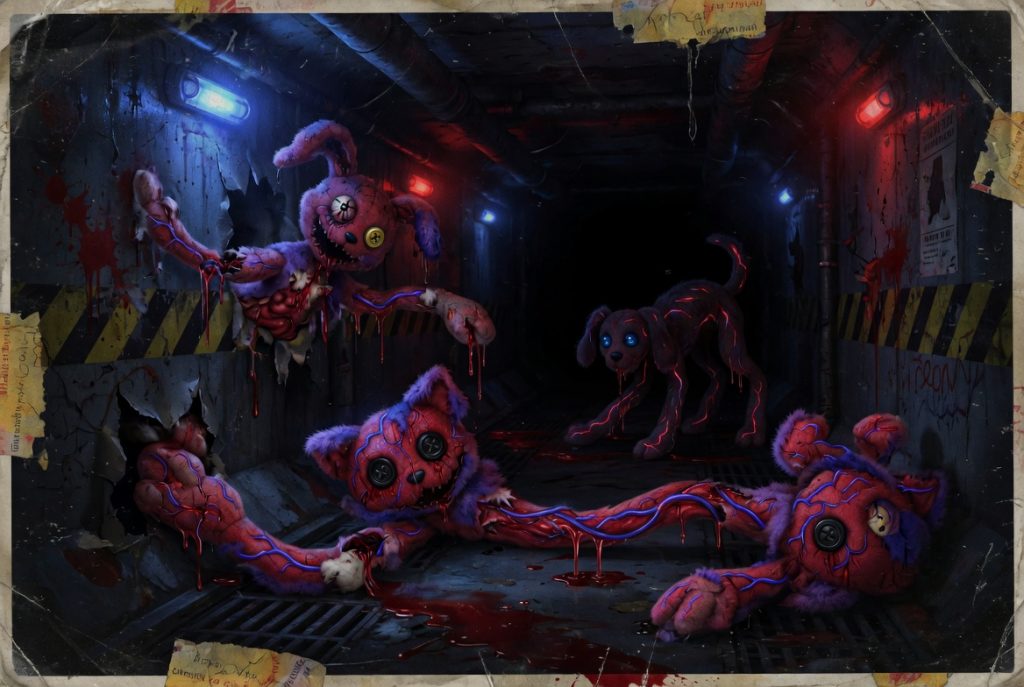
Their main vulnerability is light. This is a key survival mechanic in their domain. The player must turn on all available lamps and use Glowby's flashlight to drive the creatures away. They are literally made of darkness - and therein lies their deep metaphorical connection to the factory, plunged into eternal night after the Hour of Joy.
The connection to the Prototype is traced here on a systemic level. These creatures are not just mutated beasts, but a prime example of what the Prototype turns even defective toys into. They are the perfect guardians for the lower levels: they don't need to be controlled directly, but simply plunge a sector into darkness. The Prototype, having control over the factory's systems, uses them as a living trap.
Giblet: A lame strategist with a fighter's heart.
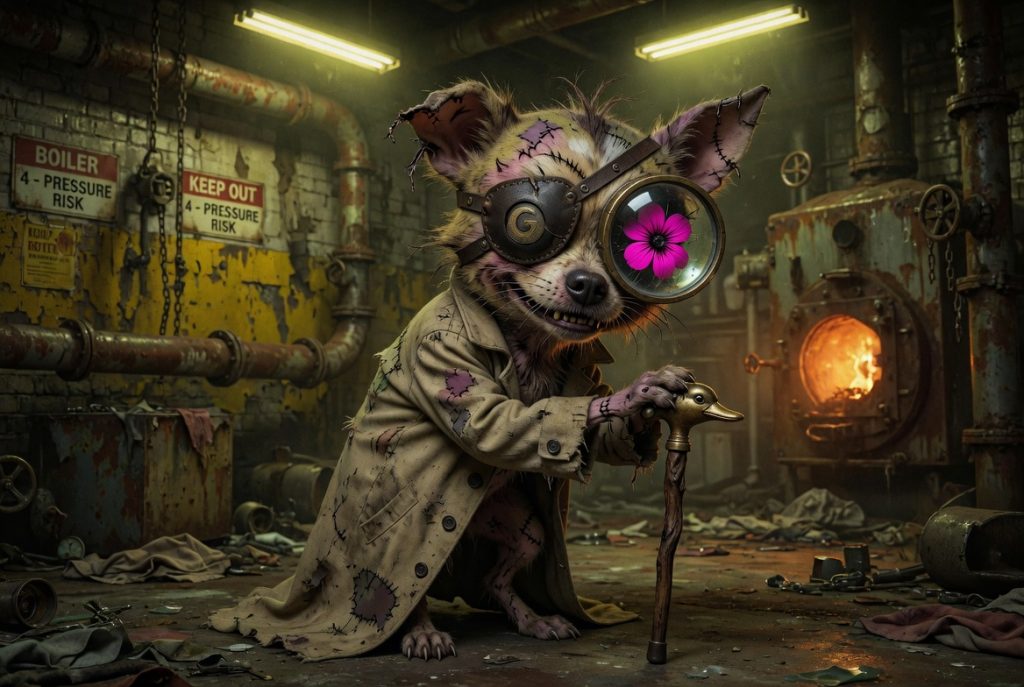
When it seems there is no hope, out of the darkness he appears - Giblet.. Small, lame, with a patch over his eye and a permanent cane in his paw, this character instantly breaks the stereotype of what a hero should look like. Unlike the silent Prototype or the aggressive Werewolves, Giblet greets the player with a speech - and his first words set the tone for the rest of the journey.
In appearance, Giblet resembles a litter of chihuahua, fox, and wolf, assembled from disparate pieces of fur. One of his eyes is a magnifying glass with a pink flower pupil, and the other is hidden under a leather patch. He wears a long double-breasted coat and leans on a cane due to a severe limp in his left leg. His body is covered in scars and patches - Giblet looks like he was assembled from parts of other toys.
But don't judge by appearances. As the story shows, Giblet is one of the few survivors of the Hour of Joy who hasn't broken down and fallen into madness. His goal is simple and clear: to stop the Prototype and free all those still imprisoned in the factory.
Of particular note is his background. According to the game notes, Giblet was created in late 1990 and early 1991 as part of the Experiment 1202 program. His original purpose was to be a protector of children from scary things, which lends a special, bitter tinge to his current mission.
His relationship with the Prototype is antagonistic to the core. The Prototype wants Giblet dead as much as he wants the Protagonist dead. This mutual hatred makes Giblet not just a temporary ally, but the driving force behind the resistance. He is the one who knows the secret of the Negation Compound, the only substance capable of destroying the Prototype. In essence, Giblet is living proof that even in the pitch black hell of the factory, it is possible to retain the will to fight.
Chum Chompkins: A double agent with a mouth on his belly.
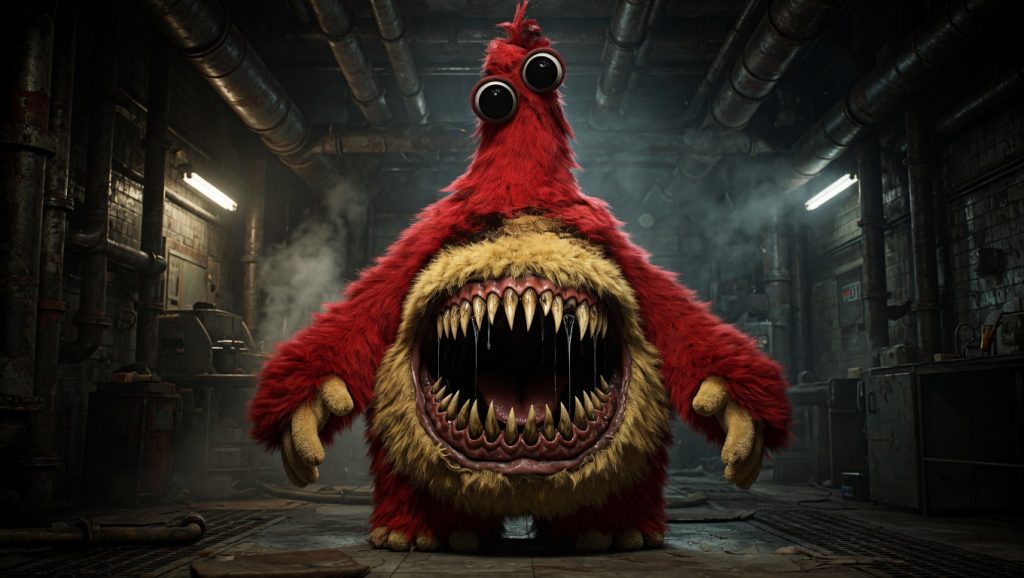
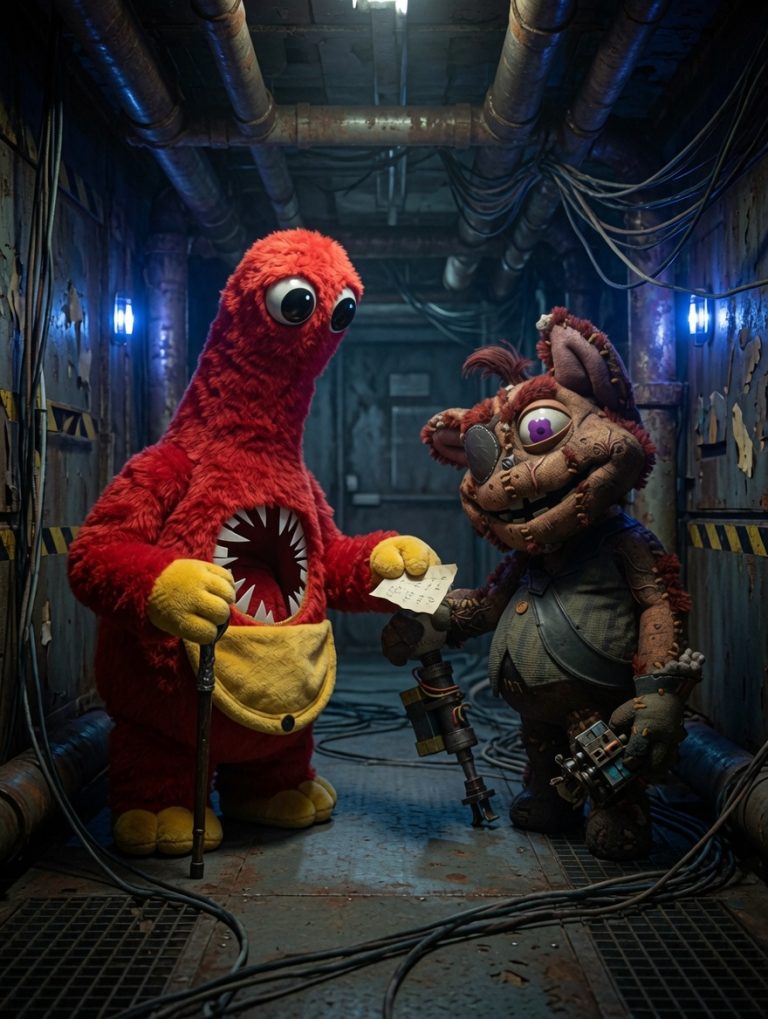
While Giblet is sympathetic and eager to help, Chum Chompkins inspires barely concealed anxiety from the first meeting. Chubby, red-furred, with short limbs and four-toed paws covered in a Velcro-like texture, he seems to be a distorted reflection of Huggy Wuggy and Kissy Missy's family. But what's most disturbing about his appearance is his huge mouth, located right on his belly.
Yeah, it's not a metaphor. Cham's jaws are so large that they can swallow an adult human whole. When Cham first appears, he grabs the player and nearly eats him, showing his true, frightening nature.
However, the Broken Things lore reveals a much more complicated picture. Officially, Chum is a henchman of the Prototype, one of his enforcers on the lower levels. But secretly from his master, he works as an informant for Giblet, leaking him data on the antagonist's movements and plans. This double game makes Cham one of the most unstable and intriguing figures of chapter five.
Why is Cham helping Giblet? Game notes hint at an old friendship or duty binding these two characters long before the events of the chapter. Giblet mentions that Cham should not continue to deliver so many provisions to him, from which it can be inferred that the red giant is supplying his ally's hideout with supplies at the risk of being discovered.
The connection to the Prototype is particularly interesting here. Cham is a living illustration that the Prototype's power is not absolute. Even among his inner circle, discontent is brewing. This sets an important precedent: if a seemingly loyal servant like Cham is playing a double game, how many other loyal toys are there really waiting to be played?
Lily Lovebraids: The crazy hostess of the doll's tea party.
It's impossible to talk about chapter five without devoting the lion's share of attention to Lily Lovebraids - perhaps the most frightening Mob Entertainment creation since the original Huggy Wuggy. While the previous antagonists in the series were frightening in their physical power and predatory instincts, Lily strikes at the heart of the matter - psychology.
She is an articulated doll with tanned skin, a complete lack of nose, huge oval eyes with black irises, and a permanent smile that exposes unnaturally white teeth. Her trademark is her long purple braids, which she uses as grasping limbs. It is with these braids that Lily immobilizes her victims and drags them into her dollhouse.
Lily's outfit emphasizes her tragicomic nature: purple shirt, black suspenders, star embroidery. She looks like a toy from an expensive store that has been forgotten on the shelf for too long, and in the meantime something inside it has broken irrevocably.
Voiced by Nicole Tompkins (known for her role as Jill Valentine in the Resident Evil remakes), Lily teeters on the edge between childlike directness and frightening insanity. She kidnaps Poppy and Kissy Missy, then forces the player to play a tea party game with her - searching for her three missing friends in exchange for information.
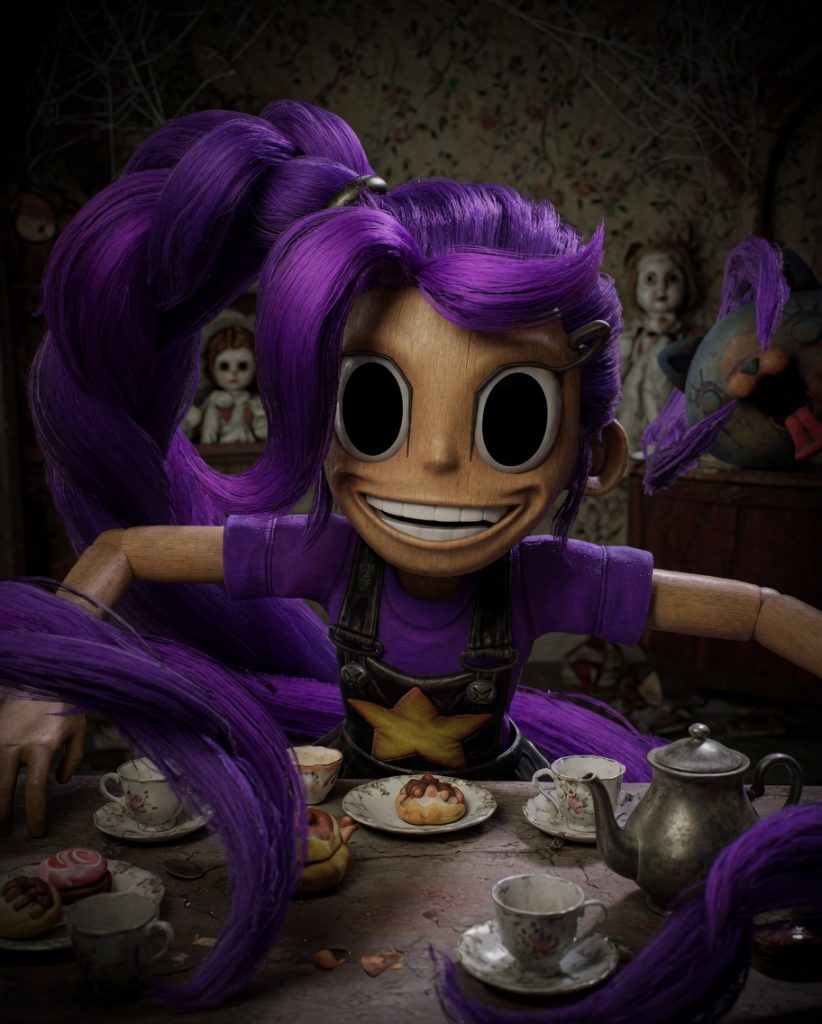
Lily's story is the story of a slow plunge into madness. She was originally a person named Gracie Green, one of the employees of the Big Bodies program. But after the Joy Hour, finding herself locked in the Sweet Street section in total isolation, she has lost all memories of her human life and identifies completely as a doll.
Lily's bond with the Prototype is tied to her desperate need for approval. She is deeply loyal to the Prototype and believes that if she honors him - in particular by delivering Poppy and the protagonist - he will allow her and her "friends" to go to some "Better Place". This blind faith, bordering on religious fanaticism, makes Lily the perfect tool in the hands of the Prototype. She doesn't just follow orders; she truly believes she is serving a higher purpose.
The Prototype (Experiment 1006): The puppeteer comes into the light
While the Prototype is not a new character in the full sense of the word, it is in chapter five that he first appears to the player in his true, physical form. For four chapters we've heard his voice, seen his shadow, felt his influence - but Broken Things rips away the shroud of mystery for good.
It is a colossal mechano-organic creature whose body is an eerie hybrid of spider limbs and human features. His face is a cracked porcelain jester mask with a single glowing mechanical eye. Attached to his body are limbs and parts of other toys that have fallen at his hand - each such piece serving as both a trophy and a functional element.
But what really turns the perception of a character upside down is the revelation of his personality. Behind the mask of the Prototype is Oliver Ludwig, the son of the factory's founder, Elliot Ludwig. This means that Poppy, created in the image of Elliot's daughter, is his sister. This information retroactively redefines all their interactions in the previous chapters: the Prototype's enigmatic concern for Poppy, his reluctance to harm her directly, all take on a new, tragic meaning.
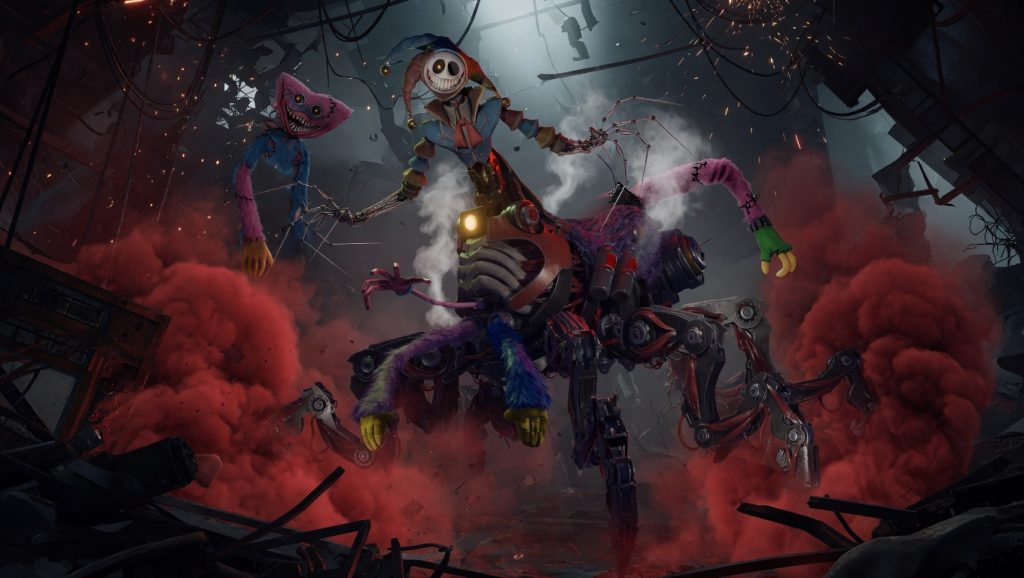
Gameplay-wise, the Prototype acts as an omnipresent threat in this chapter. He's not just the final boss; his presence is felt in every corridor, every dark corner. He's the one who controls the factory's systems, he's the one who pits the Werewolves against uninvited guests, he's the one who pulls the strings and makes Lily dance to his tune.
Yet the fifth chapter brings an unexpected ambiguity to his character. There are moments when the Prototype seems to save the protagonist - or at least prevent him from dying before his time. He even throws the protagonist into a vat of Poppy gel, a substance that turns people into toys. Why? Perhaps to make him stronger for the final confrontation. Maybe because the Prototype's plans are more complicated than just killing him..
Kissy Missy: Silent victim of circumstance.
Kissy Missy has appeared before, but in Broken Things her role undergoes a significant change. In chapter five, she appears not as a mysterious ally from the shadows, but as a captive in need of rescue. Lily Lovebrads kidnaps her along with Poppy, and much of the player's motivation is tied to their release.
Kissy still retains her trademark pink coloring and feminine features, contrasting with the blue Huggy Wuggy. But in this chapter, her familiar smile is not a harbinger of attack, but a grimace of pain and despair. She's one of the few toys who hasn't succumbed to madness and gone over to the Prototype's side.
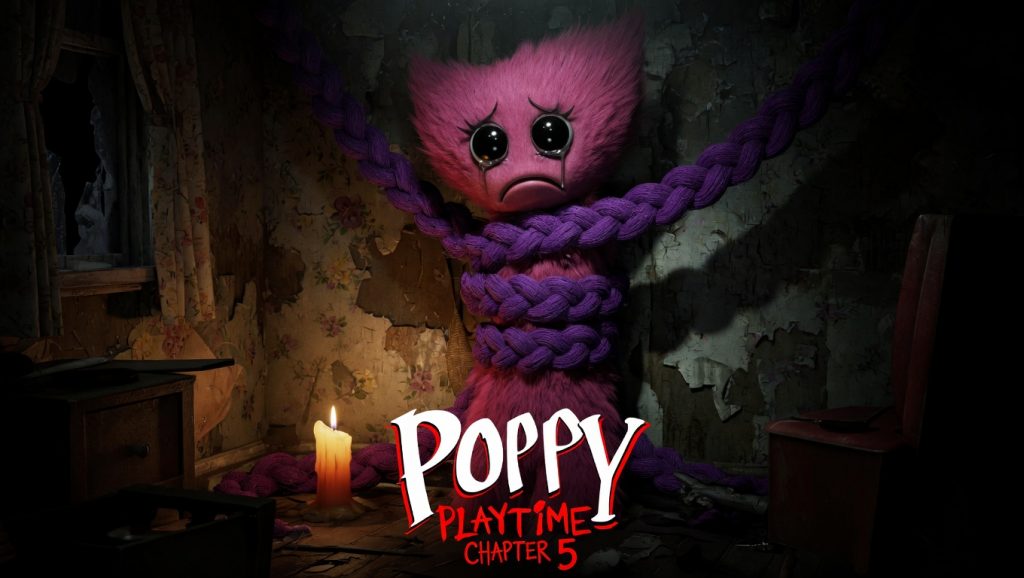
Kissy's connection to the Prototype is tragic. She is a direct product of the same experimental program as Huggy, and thus a direct property of the Prototype from his point of view. The fact that she dared to help the Protagonist makes her a traitor in the Antagonist's eyes. And in chapter five, he is determined to bring the fugitive back under his control - at any cost.
Huggy Wuggy: The Return of the Broken Guardian
The blue giant who became the face of the franchise returns in Broken Things - but it's far from a triumphant return. Huggy Wuggy, once the main horror of the first chapter, now appears in a "broken" state: his body is covered with cracks, his movements are twitchy, and his famous smile seems more like a suffering grimace than a threat.
However, it would be a mistake to write him off. The chase scene at the beginning of the chapter proves that even a weakened Huggy remains a deadly predator. He pursues the protagonist with manic persistence, as if following the last order embedded in his program code.
Game notes found during the course of the passage shed light on Huggy's methods of "training" under Miss Gracie. The flashback system used by the protagonist in the fifth chapter allows you to literally look into Huggy's mind and see what circles of hell he went through before becoming an obedient tool in the hands of his creators.
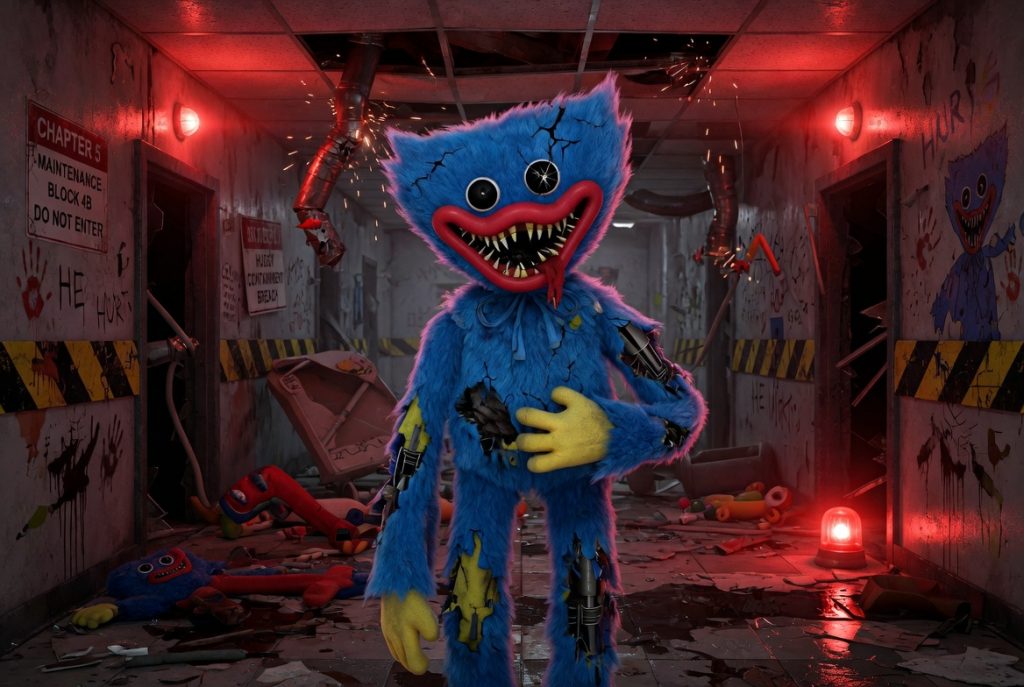
Huggy's connection to the Prototype in Broken Things is taken to a new level. Whereas before it seemed that Huggy was an independent monster driven by hunger and aggression, now it becomes clear: he has always been a pawn in a larger game. The prototype uses him as a chain dog, siccing him on anyone who dares to enter his domain.
The Doctor (Harley Sawyer): An evil genius in a digital shell
Dr. Harley Sawyer, the main antagonist of the fourth chapter, returns in Broken Things - but in a very unexpected form. After the player destroyed his physical incarnation in Safe Haven, Sawyer's mind was uploaded into the factory's backup computer system. He now exists as a digital entity, able to interact with the protagonist through terminals and screens.
The Doctor is the creator of the Big Bodies Initiative, the very program that turned orphans into giant toys. All the characters, from Huggy to Lily, are literally his brainchildren.
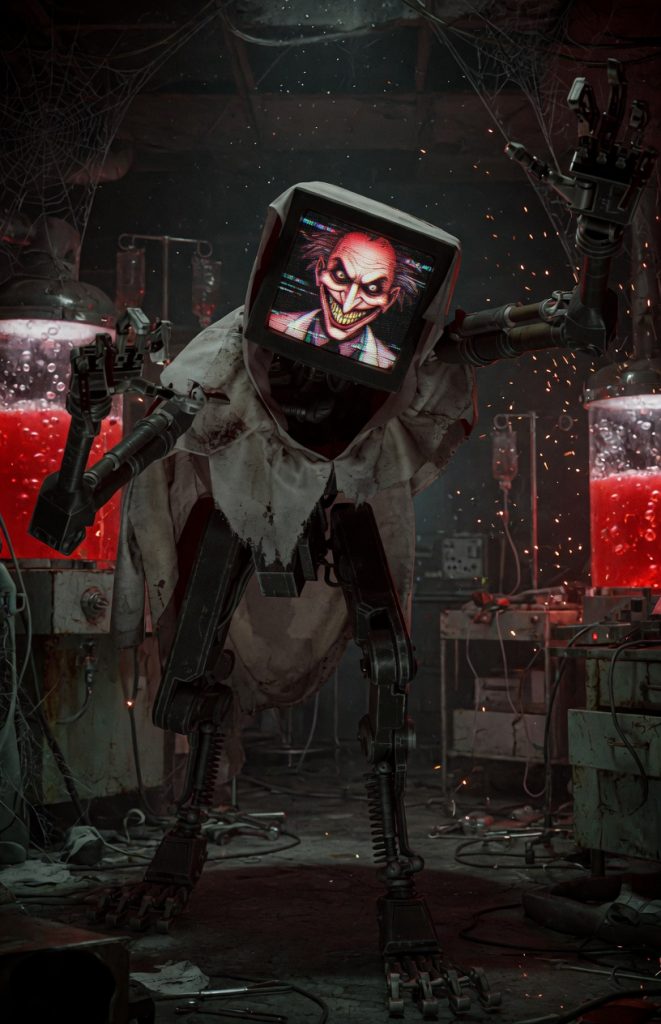
The Doctor's connection to the Prototype is complex and multi-layered. On the one hand, Sawyer was one of the creators of Experiment 1006. On the other, after the Hour of Joy, he lost control of his creation. Their relationship in chapter five is a mixture of mutual hatred and forced coexistence. Sawyer helps the protagonist not out of altruism, but because destroying the Prototype is the only way for him to break free.
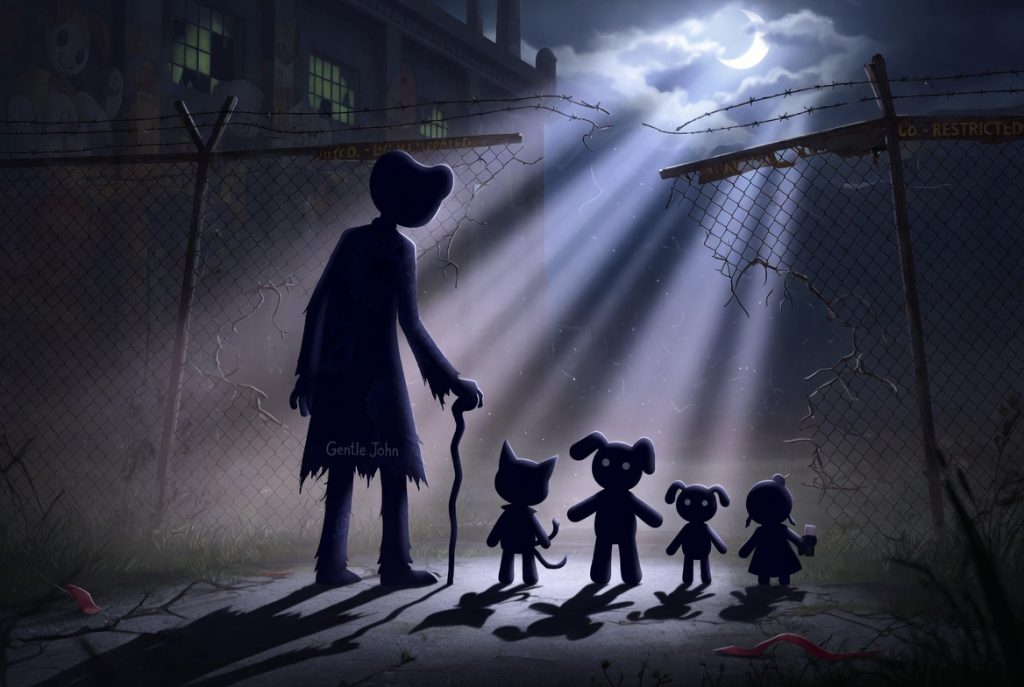
Gentle John and The Joyless: Shadows of the Runaways.
Among the many notes scattered throughout the levels of Chapter Five, a special mention of Gentle John and a group of toys calling themselves The Joyless stands out. According to these documents, Gentle John was the leader of a group of toys that managed to do the unthinkable - escape from the factory during the Joy Hour.
For a long time, rumors circulated in the factory that Gentle John and his followers had been murdered. But the notes in Broken Things disprove this theory: they had indeed escaped, and Prototype, in order not to undermine his authority, fabricated evidence of their deaths.
Although Gentle John does not physically appear in the game, his very existence drastically changes the perception of the entire lore. It turns out that getting out of this hell is possible. And the fact that Prototype went rogue, hiding the truth about the escape, says more about his vulnerability than any direct confrontation.
How new characters change lore
The appearance of such an extensive cast in one chapter is not just a desire of the developers to add action. Each new character serves a specific purpose in building the universe.
- The fragmentation of mythology: Whereas before we had a binary system of Prototype vs. everyone, now we see a complex ecosystem with factions and dual agents. Giblet and Chum represent loyal opposition; Lily, religious worship; the Doctor, cynical exploitation.
- Disclosure of the Prototype through others: We understand the nature of the antagonist not through his monologues, but through how those around him react to him. Lily idolizes him; Giblet hates him; Chum fears him but betrays him; the Doctor sees him as a mistake to be corrected.
- Expanding the geography of evil: We used to explore the factory piecemeal. Now, as we meet characters from different segments of the factory, we see the whole picture - the Prototype controls all levels, from recycling (Wykworotny) to research labs (The Doctor) to entertainment areas (Lily).
- The theme of broken things: The chapter title is no accident. Each new character - whether it's a limping Giblet, a cracked Huggy, or a mad Lily - is a metaphor for a broken toy that continues to function against all odds.
- A grain of hope: Escape of Gentle John proves that the system is not omnipotent. This changes the tone of the entire narrative from a hopeless horror to a story of resistance.
Comparative table of new characters
| Character | Experiment | Type | role | Link to Prototype | Status |
|---|---|---|---|---|---|
| Wrongside Outimals | Unknown | Hostile | Guardians of the lower levels | Used as passive defense | Active |
| Giblet | #1202 | Union | Resistance strategist | A personal enemy, hunting for his secret. | Alive |
| Chum Chompkins | Unknown | Double agent | Giblet's informant | A henchman secretly working against him. | Alive |
| Lily Lovebraids | #1468 | Hostile | Secondary antagonist. | Religious worship, believes in "A Better Place." | Active |
| The Prototype | #1006 | The main antagonist | The puppeteer of the factory | - | Active |
| Huggy Wuggy | #1170 | Hostile | Prototype's chain dog | Subordinate, used for hunting | Broken |
| Kissy Missy | #1172 | Union | Lily's captive | The subject of the return to control | Captive |
| The Doctor | - | Neutral | Digital Essence | The Creator, now seeking to destroy | Digital form |
| Gentle John | Unknown | Mentioned | The leader of the runaways | A symbol of resistance, his escape is hidden | Ran away |
FAQ
Question 1: How many new characters appear in Poppy Playtime Chapter 5?
Four brand new characters physically appear in the chapter: Giblet, Chum Chompkins, Lily Lovebreads, and Wrongside Outimals. Additionally, Dr. Harley Sawyer returns in digital form, and the Prototype's appearance is fully revealed for the first time. Gentle John is also mentioned, though he does not physically appear.
Question 2: Who is Lily Lovebrads really?
Before being turned into a doll, she was Gracie Green, a Playtime Co. employee working on the Big Bodies program under Miss Gracie's supervision. After the Joy Hour, she found herself locked away in solitude and gradually lost all human memories, identifying completely with the doll role.
Question 3: Why does Giblet help the protagonist?
Giblet is one of the few survivors of the Hour of Joy who has retained his sanity and will to resist. His goal is to destroy the Prototype and free the remaining survivors of the toy factory. The Protagonist is the first ally in a long time who can make a real difference in the situation.
Question 4: Is Cham a friend or an enemy?
Technically both. Officially he serves the Prototype, but secretly he works as an informant for Giblet. This makes him an extremely unreliable ally: you can never be sure if he'll turn you in to your master at a crucial moment.
Question 5: Why doesn't the Prototype kill the protagonist immediately?
This is one of the central questions of chapter five. Perhaps the Prototype sees in the Protagonist the potential for a new experiment (he throws him into Poppy's vat of gel). Perhaps he needs a witness to tell the outside world of his power. Or perhaps he is motivated by more complex motives related to his human past.
Question 6: Who is Gentle John?
The leader of a group of toys called The Joyless, who managed to escape from the factory during the Joy Hour. His story is revealed through notes; he doesn't physically appear in the game, but his very existence is an important plot twist that proves escape is possible.
Question 7: Is Lily Lovebreads voiced by a famous actress?
Yes. The role of Lily Lovebrads was played by Nicole Tompkins, known for her role as Jill Valentine in the remakes of Resident Evil 2, 3 and 4. Her voice gave the character a unique blend of childlike innocence and frightening obsession.
Question 8: Do any of the characters die in chapter five?
Near the finale, Prototype apparently puts an end to both Huggy Wuggy and Kissy Missy. However, given the history of resurrections in the series, the ultimate fate of these characters remains in question.
Question 9: Will the Doctor return in the next few chapters?
Yes. In chapter five, Harley Sawyer returns as a digital entity and actively interacts with the protagonist. His motivation is to destroy the Prototype, but his true plans remain murky.
Question 10: How many total experiments are presented in chapter five?
The main experiment numbers mentioned or appearing in the chapter are #1006 (Prototype), #1170 (Huggy Wuggy), #1172 (Kissy Missy), #1202 (Giblet), #1468 (Lily Lovebrads).
Conclusion
Poppy Playtime Chapter 5: Broken Things is not just another chapter in a horror series. It's an encyclopedic expansion of the universe, transforming it from a story about a scary factory into a full-fledged mythology with factions, betrayals, and complex moral dilemmas. The Prototype is no longer a faceless threat from the shadows - it gains a face, a voice and, worst of all, a motivation that you can almost understand. Lily, Giblet, Chum, and the others are not masses; each adds a unique color to the grim palette of the abandoned factory. And now that all the cards have been revealed, the only question left is: who is really the puppeteer and who is really the puppet?
 English
  Русский
  Español
  Português do Brasil
  Türkçe
  Deutsch
  Français