Introduction
Poppy Playtime Chapter 2 turns an abandoned toy factory into a giant slot machine. Mommy Long Legs, the mistress of this nightmare, doesn't just stalk the protagonist: she forces him to play by her rules. Three tests that the player passes in the lair of Mommy, at first glance seems a cruel parody of children's attractions. But behind the brightly colored buttons, beeping hammers, and creepy game of "freeze" lies a whole layer of untold stories.
Each mini-game in Fly in a Web is a key to understanding exactly how the Playtime Co. factory broke its subjects. These are not just obstacles on the way to the train - they are preserved fragments of the educational program that turned living beings into obedient toys. We went through each test dozens of times, looked at all the posters on the walls and collected a full dissection of the hidden meaning of all Chapter 2 mini-games.
Mini-game 1: Musical memory - obedience test
The first thing the player sees upon entering the Mommy game zone is a huge cylindrical room with four different-colored buttons: red, blue, yellow and green. The rules are simple: remember the sequence of colors and sounds that the machine beats and repeat it without a single mistake. With each round, the sequence gets longer and the time to answer gets shorter.
On a gameplay level, it's classic Simon Says - a memorization game familiar to every kid from the eighties. But take a closer look at the details, and a harmless arcade turns into a document about the methods of Playtime Co.
First of all, the sounds the machine makes are not random tones. They are short musical phrases, very similar to the lullaby heard in the commercials for Banzo Bunny. Banzo is a yellow rabbit with a xylophone, one of the symbols of the Smiling Critters line, whose purpose is to soothe children before bedtime. Forcing the experiments to memorize this particular melody, the factory literally hammered into their minds a conditioned reflex: if you hear Banzo's lullaby, you calm down and obey.
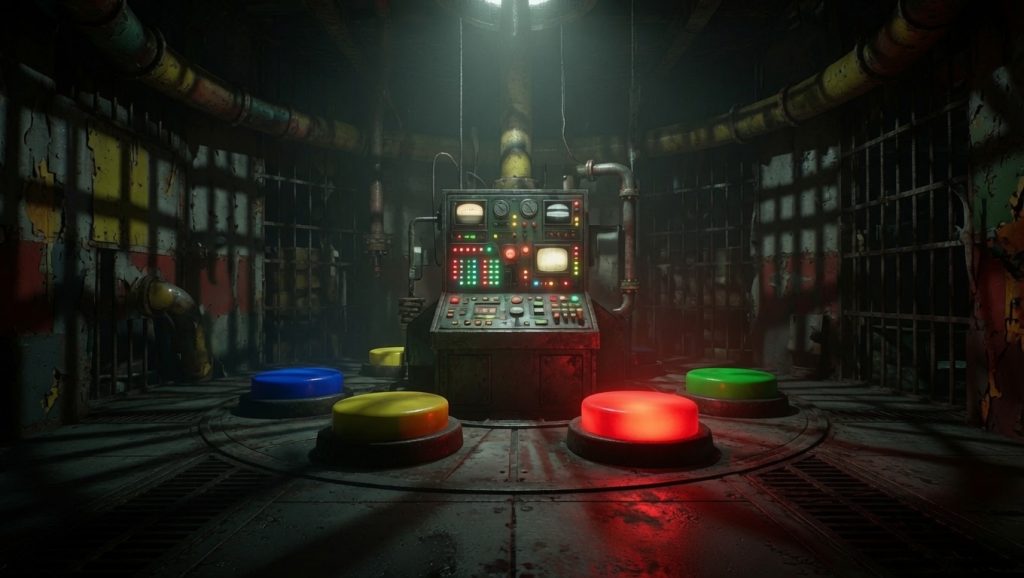
Second, if a player makes a mistake, Mommy doesn't just comment on the failure - she punishes. The electric shock that pierces the room is not a special effect. It's a direct reference to the behavioral correction techniques described in the notes of Dr. Harley Sawyer. Experiments that didn't follow commands received an electric shock. Each time the strength of the shock increased - until the subject either began to obey the first time or died.
Third, look closely at the walls around the buttons. There you can see faded children's drawings: little people holding hands and a large figure with long arms hugging them all. This is Mommy. The children who fell into her clutches saw her as a protector - until they learned the truth.
Mini-game 2: Wack-a-Wuggy - Hammer of Fate
The second challenge looks almost comical: the player is handed a huge inflatable hammer, and small versions of Huggy Wugs start popping out of holes in the wall. The goal is to hit as many blue Huggies as possible and never hit the gold ones. At first glance - the usual attraction hit the hammer on the head, but with a branded character.
But the reality of this challenge is much darker. Wack-a-Wuggy is not a game. It's a recycling manual.
There are posters hanging on the walls of the room. One of them reads, "Wuggy gone bad? Report to your supervisor immediately." Another says, "If you see something, say something." The third says, "Defective toys must be destroyed." Translation: "Wuggy gone bad? Report to your supervisor immediately", "If you see something, say something", "Defective toys must be destroyed".
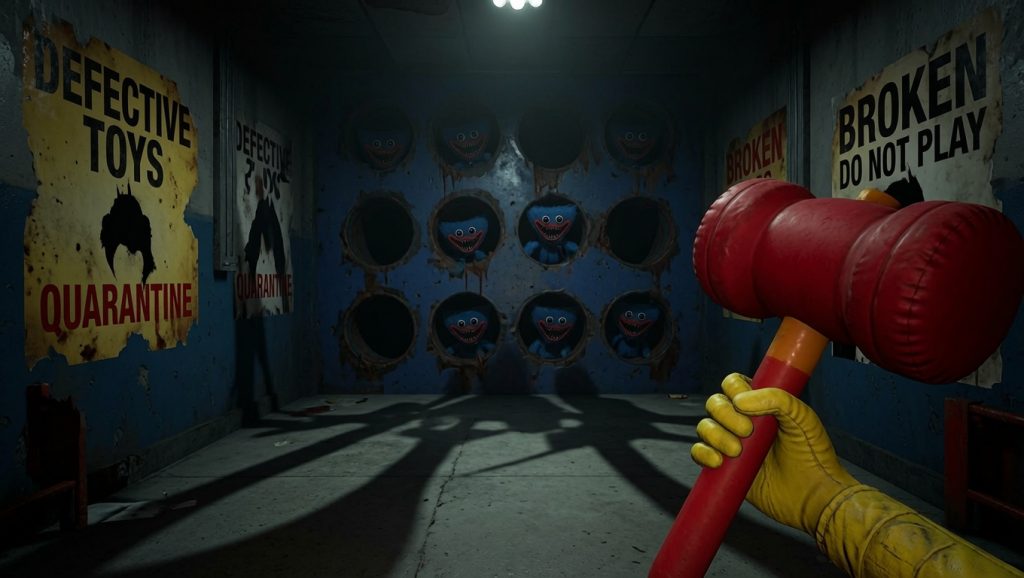
The golden Huggies that can't be beaten are the successful experiments that have passed all tests. The blue ones are the ones to be written off. The player is literally taught to distinguish the good toys from the bad and destroy the latter. Considering that every toy in the factory was once a human being, this test takes on a completely different, chilling meaning.
There's another detail: if you look closely at the blue Huggies popping out of their holes, some of them have little number tags on their chests. These aren't random numbers - they're experiment numbers. One of them is #1170, the number of Huggy Wuggy himself. Mommy makes you beat a replica of the very creature that hunted you in the first chapter with a hammer. Bullying? Revenge? Or just a reminder that everyone here is expendable?
Minigame 3: Statue - Freeze or Die
The final and most terrible challenge of Mommy is the game Statue. The rules are familiar to everyone who has ever played Sea Waves Once: when the music plays - you can go, when it stops - you need to freeze. If Mommy notices movement - death.
The playroom for the Statue is a dark, green-lit corridor with columns. At the end of the corridor is a door. The way to it is through several freeze cycles. But the main horror isn't the mechanics, it's who's watching you. Mommy isn't just watching - she's crawling along the walls and ceiling, her long limbs wriggling in the dark, and her face with empty eye sockets turning in your direction every time the music stops.
This game is a direct reference to the total control system practiced by the Playtime Co. Production reports scattered throughout the factory mention a surveillance protocol in which every experiment was monitored around the clock. Cameras, motion sensors, personnel, snitches - no movement went unnoticed.
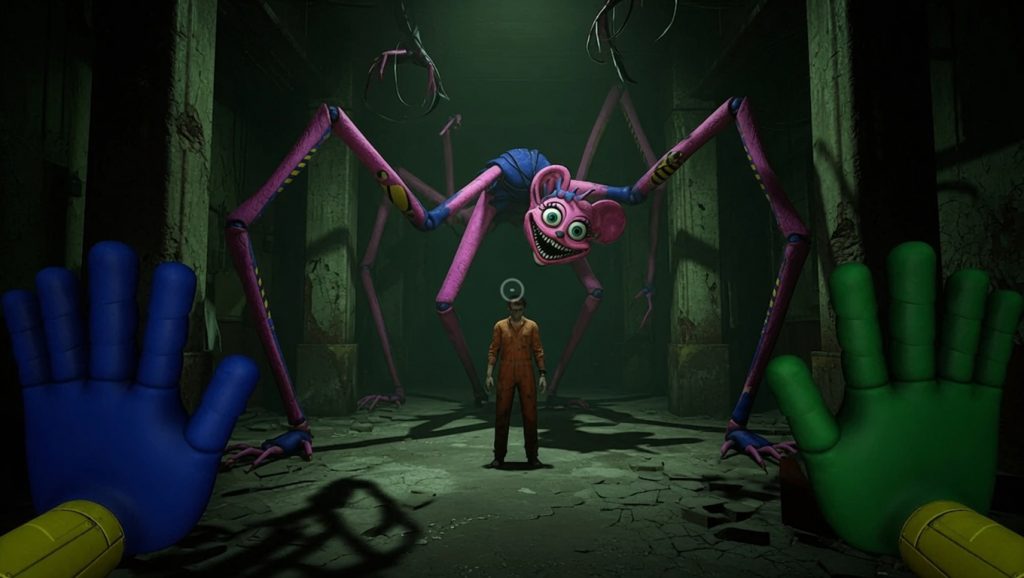
But there is a more personal interpretation. Mommy herself is a former employee named Mary who was betrayed and turned into a spider. Her obsession with control, her desire to make others freeze on command, isn't just sadistic. It's trauma. She forces the protagonist to relive the same sense of helplessness she herself felt when her body was changed and she couldn't move, suspended in the transformation chamber.
On the walls of the corridor, if you catch the moments of freezing, you can make out shadows - not of the player, but of someone else. They are the silhouettes of previous victims who didn't freeze in time. Their outlines are melted into the concrete, like a reminder: you are not the first to play this game. And not everyone made it to the end.
The common hidden meaning of all three trials
If you look at the three mini-games as a single system, a frightening picture emerges. This isn't just a random assortment of activities. It is a complete toy preparation program, reproduced by Mommy with frightening accuracy:
| Test | Skill | Lore reference |
|---|---|---|
| Musical memory | Memorizing commands and obeying audible signals | Banzo Bunny's Lullaby as a conditioned reflex, an electric shock for mistakes |
| Wack-a-Wuggy | Recognizing marriage and destroying it | Instructions for disposing of defective experiments |
| statue | Full body control, ability to freeze on command | Total Surveillance Protocol and the experience of transformation of Mommy herself |
All three tests have one goal in common: to turn a living being into an obedient mechanism. First, it is taught to respond to sound (Musical Memory). Then they explain what happens to those who fail (Wack-a-Wuggy). And in the final stage, absolute obedience is demanded, when on command it must freeze and not breathe (Statue). These aren't games. It's a conveyor belt.
And Mommy, having gone through this conveyor belt herself, is now reproducing it for the protagonist. Not because she needs information or because she wants to have fun. It's because it's the only way she knows how to interact with the world. She doesn't know any other way.
FAQ
Question 1: Why exactly three mini-games?
The three stages correspond to the three stages of rearing experiments according to Dr. Sawyer's methodology: learning of commands (memory), selection (choosing the correct ones), and final control (obedience).
Question 2: Who is Banzo Bunny and why is his tune in the music game?
Banzo Bunny is one of a line of Smiling Critters, a yellow rabbit with a xylophone designed to soothe children. His lullaby was built into the experiments' training program to induce a state of submissiveness in them.
Question 3: What do the golden Huggies mean in Wack-a-Wuggy?
Gold Huggies symbolize successful experiments - those that have passed all tests and have been deemed fit for use. They are not allowed to be beaten - unlike the defective blue ones.
Question 4: Are the shadows in the corridor of the Statue alive?
These are not living creatures, but the imprints of the victims who died in this ordeal. Their shadows are imprinted into the walls, another grim warning from the developers.
Question 5: Was Mommy a human being?
Yes, in the past she was Mary, a factory employee who was turned into a spider as punishment. Her cruelty and obsession with games is a distorted reflection of her own trauma.
Question 6: Can I skip the mini-games?
No, all three trials are mandatory to progress through the story. However, a close examination of the environment allows you to see hidden details without affecting the passage.
Conclusion
The mini-games in Poppy Playtime Chapter 2 are much more than just gameplay inserts between chases. They're a window into the factory's past and into the soul of Mommy Long Legs herself. Where the average player sees an arcade game, the careful researcher finds a brainwashing manual, a recycling manual, and a diary of a trauma experienced years ago. Next time you replay Fly in a Web, listen to Banzo's music, read the posters on the walls, and linger on the shadows in the hallway. The Playtime Co. factory isn't just playing with you - it's telling you its story.
 English
  Русский
  Español
  Português do Brasil
  Türkçe
  Deutsch
  Français